
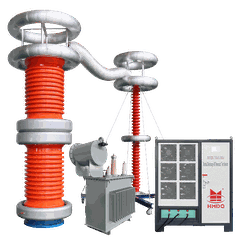


What is Hipot Test Voltage?
Hipot (High-Potential) test voltage applies over-stressed voltage (higher than operating levels) to electrical equipment to verify insulation integrity. It's the "litmus test" for dielectric strength-simulating worst-case scenarios to catch insulation flaws before catastrophic failures occur.
Types of Hipot Tests
AC Hipot
Uses alternating current voltage.
Ideal for detecting creepage or contamination faults (e.g., in transformers).
DC Hipot
Applies direct current voltage.
Better for detecting pinholes in insulation (common in cables).
Key Difference: AC tests stress insulation uniformly but risk capacitive discharge; DC tests are safer for capacitive loads but slower.
How Hipot Testing Works: The Science
Principle: Apply 1.5–3x operating voltage for 1–5 minutes.
Failure Signs: Current leakage > preset threshold = insulation breakdown.
Critical Insight: It's not just "pass/fail"-leakage current patterns reveal aging components (e.g., partial discharge in switchgear).
Applications: Where Hipot Tests Save Lives
Power Cables: Prevents underground cable explosions.
Switchgear: Avoids arc flashes in substations.
Consumer Electronics: Ensures compliance with IEC/UL safety standards.
Case Example: A utility company averted a grid outage by catching degraded insulation in a 33kV transformer during routine hipot testing.
How to Choose Hipot Test Parameters: 4 Key Factors
Voltage Level
Rule: AC Test = 2 × Operating Voltage + 1 kV; DC Test = 2 × AC Test Voltage.
Test Duration
Standard: 60 seconds. Extend to 15 mins for thermal stress analysis.
Test Type
Choose AC for grid equipment, DC for long cables or capacitive loads.
Safety Compliance
Align with IEC 60255 (relays), IEEE 433 (motors), or UL 60335 (appliances).
Pro Tip: Always test at 25%–100% of rated capacity to avoid damaging sensitive components.
Hipot Testing vs. Insulation Resistance (IR) Testing
| Aspect | Hipot Test | IR Test |
|---|---|---|
| Purpose | Simulate worst-case stress | Measure insulation health |
| Voltage Applied | Destructively high | Non-destructive (500V–5kV) |
| Best For | Pre-commissioning safety | Predictive maintenance |
Top 3 Safety Practices
Ground Before Testing: Discharge capacitive loads to avoid shocks.
Use Remote Controls: Operate testers from shielded zones.
Monitor Leakage Current Trends: A sudden spike hints at imminent failure.
Why Hipot Testing is Non-Negotiable
A hipot test voltage isn't just compliance-it's a reliability insurance policy. For utilities, manufacturers, or maintenance crews, skipping it risks fires, downtime, and regulatory penalties. As one engineer noted:
"A 5khipottesteroncesavedus2M in transformer replacements."
Optimize your testing strategy today-because insulation failure is never an option.