

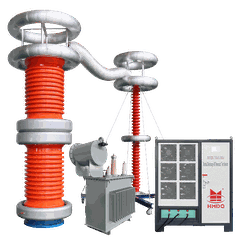


AC Resonant Test System for On-Site Testing of Extruded HV Cables
For extruded-insulated high-voltage cables (such as cross-linked polyethylene [XLPE] cables), on-site AC withstand voltage testing is a critical step in verifying cable installation quality and insulation integrity. Among the various testing methods, the variable-frequency series resonant test system has been widely recognized as the standard solution for on-site testing.

Why Is AC Resonance Necessary?
Extruded cables are typical distributed capacitive components, and long-distance lines have very high capacitance. Traditional power-frequency withstand voltage tests require test transformers with extremely high capacity, making it difficult to obtain a sufficient test power source on-site. Although DC withstand voltage testing uses more compact equipment, research both domestically and internationally has confirmed that it is ineffective for rubber and plastic insulation and can be harmful-the electric field distribution within the insulation under DC voltage differs significantly from that under AC operating conditions, and it can cause space charge accumulation, which may damage the insulation over the long term. For this reason, China's GB50150-2006 standard stipulates that AC withstand voltage testing should be prioritized for rubber and plastic-insulated cables rated at 35 kV and above.
Working Principle of Variable-Frequency Series Resonance
The system consists of a variable-frequency power supply, an excitation transformer, a resonant reactor, and a capacitive voltage divider. By adjusting the output frequency of the variable-frequency power supply, the inductive reactance of the reactor is made equal to the capacitive reactance of the cable under test, causing series resonance in the circuit. At this point, the power supply need only provide the active power required to cover the active losses in the circuit, while reactive power is exchanged between the reactor and the cable. The required power supply capacity is only 1/Q of the test capacity (where the quality factor is typically 50–80), and the weight and volume of the equipment are significantly reduced, to approximately one-tenth that of traditional equipment.
International Standards and On-Site Applicability
According to the IEC 60840 (high-voltage cables) and IEC 62067 (ultra-high-voltage cables) standards, the frequency range for on-site AC withstand voltage tests of extruded-insulation cable systems is 20–300 Hz. The variable-frequency series resonance system operates precisely within this frequency range. When a breakdown occurs in the test specimen, the circuit immediately detunes, and the short-circuit current rapidly drops to 1/Q of the normal value, preventing the fault from propagating. The system also features multiple protection mechanisms against overvoltage, overcurrent, and flashover.
The Goldhome HMCXZ series variable-frequency series resonance test set employs a modular reactor design. Through series and parallel combinations, it can flexibly match the capacitance requirements of cables of varying lengths and voltage ratings. The product line covers voltage ratings from 10 kV to 750 kV and has been widely used for on-site acceptance and preventive testing of various extruded-insulated cables.


