



Understanding the Q Factor (Quality Factor) in High-Voltage Resonant Testing
In AC resonant withstand voltage testing, the Q factor (quality factor) is a core technical parameter that is often overlooked yet critically important. It directly determines the voltage amplification capability, energy utilization efficiency, and overall testing stability of the resonant test system. For technicians engaged in testing high-voltage equipment such as cables, GIS, and transformers, understanding the principles and functions of the Q factor is key to standardizing operations and accurately interpreting test results.
Simply put, the Q factor is a core metric for measuring the energy utilization efficiency and voltage amplification factor of a resonant circuit. Its fundamental formula is Q = ωL/R, representing the ratio of the circuit's inductive reactance to its equivalent resistance, which intuitively reflects the efficiency with which the equipment converts a small input power into a high-voltage test voltage. In a series resonance state, the inductive reactance and capacitive reactance in the circuit cancel each other out, leaving only a very small amount of energy dissipated by the equivalent resistance. Therefore, the higher the Q-factor, the lower the energy loss in the circuit, and the more pronounced the system's voltage amplification effect.

In high-voltage field testing, the Q-factor is the core advantage that sets resonance test systems far apart from traditional withstand voltage equipment. For industry-compliant AC resonant test systems, the Q-factor typically ranges from 30 to 100. This means the system can amplify the initial excitation voltage by tens of times with extremely low input power, stably outputting high-voltage test voltages that meet grid testing standards. This characteristic significantly reduces the equipment's power consumption and overall weight, mitigates on-site power supply load constraints, and makes it perfectly suited for various outdoor high-voltage testing scenarios.
In actual operations, numerous on-site factors can directly affect Q-factor performance. Issues such as poor line connections, excessive loop resistance, a humid testing environment, and aging of the equipment under test can all lead to a decline in the Q-factor, resulting in insufficient voltage rise, test voltage fluctuations, and testing anomalies. Therefore, proper wiring, maintaining a dry working environment, and appropriately matching reactor combinations are essential for maintaining the system's high Q-factor and ensuring the smooth conduct of tests.
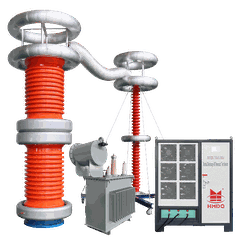
The Goldhome AC Resonance Test System employs a low-loss coil design and precise loop-matching technology to consistently maintain a high Q-factor under various complex operating conditions. It ensures low-energy-consumption operation, delivers standard sinusoidal output voltage, and provides accurate and reliable test data, offering long-term, stable, efficient, and safe technical support for high-voltage insulation testing of power equipment worldwide.


