

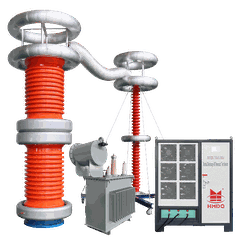



As a supplier of AC Test Transformer - Dry Type, I've witnessed firsthand the intricate relationship between load power factor and the efficiency of these transformers. In this blog, I'll delve into how the load power factor impacts the efficiency of an AC Test Transformer - Dry Type, highlighting the technical aspects and practical implications.
Understanding the Basics of AC Test Transformer - Dry Type
Before we explore the influence of load power factor, let's briefly understand what an AC Test Transformer - Dry Type is. These transformers are widely used in high - voltage testing applications. Unlike oil - filled transformers, dry - type transformers use air as the cooling medium, which makes them safer, more environmentally friendly, and suitable for indoor use. They are designed to step up the voltage for testing electrical equipment such as cables, switchgear, and insulators.
The Concept of Load Power Factor
Power factor is a measure of how effectively electrical power is being used in an AC circuit. It is defined as the ratio of real power (P) to apparent power (S), and is expressed as a number between 0 and 1. Mathematically, power factor (PF) = P/S.
A load with a power factor of 1 (unity power factor) means that all the electrical power supplied to the load is being used for useful work. In contrast, a load with a low power factor implies that a significant portion of the electrical power is being wasted in the form of reactive power. Reactive power is the power that oscillates between the source and the load without doing any useful work.
Impact of Load Power Factor on Transformer Efficiency
Copper Losses
Copper losses in a transformer occur due to the resistance of the windings. The power loss in the windings is given by the formula (P_{cu}=I^{2}R), where (I) is the current flowing through the windings and (R) is the resistance of the windings.
When the load power factor is low, the current drawn by the load for a given amount of real power is higher. This is because (P = VI\cos\theta), where (V) is the voltage, (I) is the current, and (\cos\theta) is the power factor. For a fixed real power (P) and voltage (V), a lower power factor (\cos\theta) requires a higher current (I). As a result, the copper losses ((I^{2}R)) in the transformer windings increase. Higher copper losses mean more energy is wasted as heat, reducing the overall efficiency of the transformer.
Core Losses
Core losses in a transformer consist of hysteresis losses and eddy - current losses. While the load power factor does not directly affect core losses, the increased current due to a low power factor can cause additional stress on the transformer core. This can lead to a slight increase in core losses over time, especially if the transformer is operating near its rated capacity.


Overall Efficiency
The overall efficiency of a transformer is given by the formula (\eta=\frac{P_{out}}{P_{in}}\times100%), where (P_{out}) is the output power and (P_{in}) is the input power. As the power factor decreases, the input power increases due to higher copper losses and potentially higher core losses. This results in a decrease in the overall efficiency of the transformer.
Practical Implications for AC Test Transformer - Dry Type
In high - voltage testing applications, the load power factor can vary significantly depending on the type of equipment being tested. For example, capacitive loads such as cables typically have a leading power factor, while inductive loads like motors have a lagging power factor.
When testing equipment with a low power factor, the AC Test Transformer - Dry Type has to supply more current to deliver the required real power. This not only reduces the efficiency of the transformer but also increases the risk of overheating. Overheating can damage the insulation of the transformer windings, leading to premature failure.
Mitigating the Effects of Low Power Factor
Power Factor Correction
One way to mitigate the effects of low power factor is to use power factor correction techniques. Power factor correction involves adding capacitors or inductors to the circuit to bring the power factor closer to unity. By improving the power factor, the current drawn by the load is reduced, which in turn reduces the copper losses in the transformer and improves its efficiency.
Proper Sizing of the Transformer
When selecting an AC Test Transformer - Dry Type, it is important to consider the power factor of the load. Oversizing the transformer can help accommodate loads with low power factors without overheating. However, this approach can be costly and may not be the most efficient solution in the long run.
Related Products and Their Role
As a supplier, we offer a range of related products that can complement the AC Test Transformer - Dry Type. For example, the Gas Type AC DC Hipot Tester is used for high - voltage testing of electrical equipment. It can work in conjunction with the AC Test Transformer - Dry Type to provide a comprehensive testing solution.
The DC Hipot Test Set is another important product. It is used for DC high - voltage testing, which can be useful for detecting insulation defects in electrical equipment.
The AC/DC High Voltage Divider is used to measure high voltages accurately. It can be used in conjunction with the AC Test Transformer - Dry Type to ensure safe and accurate testing.
Conclusion and Call to Action
In conclusion, the load power factor has a significant impact on the efficiency of an AC Test Transformer - Dry Type. A low power factor can lead to increased copper and core losses, reducing the overall efficiency of the transformer and increasing the risk of overheating. By understanding the relationship between load power factor and transformer efficiency, and by implementing power factor correction techniques and proper transformer sizing, we can ensure the optimal performance of the AC Test Transformer - Dry Type.
If you are in the market for an AC Test Transformer - Dry Type or any of our related products, we invite you to contact us for a detailed discussion on your specific requirements. Our team of experts is ready to assist you in selecting the right equipment for your high - voltage testing needs.
References
- Electric Machinery Fundamentals, Stephen J. Chapman
- Power System Analysis and Design, J. Duncan Glover, Mulukutla S. Sarma, Thomas J. Overbye


