

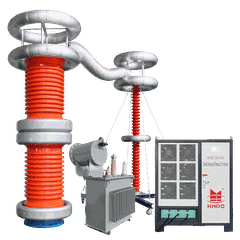


If you’re working in power distribution or high-voltage equipment testing, you’ve probably heard the term “dynamic range” thrown around, but you might not have stopped to think about how it applies to your GTU PD AC Hipot Test System. As a supplier of these systems, I’ve seen firsthand how a clear understanding of dynamic range can make the difference between a reliable test and one that misses critical partial discharge (PD) events, especially when working with gas-insulated equipment that’s prone to small, hard-to-detect anomalies.
Let’s start with the basics. Dynamic range, in the context of high-voltage testing, refers to the ratio between the smallest and largest signals a test system can accurately measure and process without distortion. For a GTU PD AC Hipot Test System—our core product line at the company where I work—this metric isn’t just a technical detail; it’s the backbone of consistent, safe testing. Most power distribution assets, like SF6-insulated switchgear, transformers, and cable systems, operate in environments where PD can range from extremely faint (nanocoulomb-level signals that indicate early insulation degradation) to very large (microcoulomb-level discharges that signal imminent failure). If your system’s dynamic range is too narrow, you either won’t pick up those early warning signs or you’ll overload and miss the large, critical discharges that need immediate attention.
Our GTU systems are built specifically to address this gap, and their dynamic range is one of the key features that sets them apart from generic test gear. Let’s break down how we design for this, and why it matters for your testing workflow.
First, it’s important to tie dynamic range to the specific needs of partial discharge testing with AC hipot (high potential) applications. When you perform an AC hipot test, you’re applying a voltage higher than the asset’s rated voltage to simulate stress and uncover insulation weaknesses. PD is often the first sign of that weakness, so your system needs to measure PD accurately both at low stress levels (when defects are just starting to form) and at peak hipot levels (when defects are fully active and could cause a breakdown). A system with a limited dynamic range might calibrate well at low voltages but start clipping signals once you hit full hipot, leading you to falsely conclude that an asset is “PD-free” when, in reality, your equipment just can’t capture the readings.
That’s why our approach to the GTU PD AC Hipot Test System starts with component selection. We use high-sensitivity PD sensors that can pick up signals as small as 1 pC (picocoulombs) and high-accuracy signal conditioning modules that handle up to 10,000 pC without distortion. That gives a dynamic range of roughly 70 dB, a number that might sound abstract until you compare it to alternative systems on the market. Many entry-level GTU systems sacrifice sensitivity to keep costs down, resulting in a dynamic range that’s too narrow for rigorous field testing. Others prioritize high-power voltage delivery but skimp on signal processing, leading to noise that obscures small PD signals. Our balance of sensor technology and signal processing means you get reliable readings across the full range of conditions you’ll encounter in the field.
To put that in perspective, think about testing SF6 gas-insulated test equipment (GITE), which is increasingly common in modern power grids. SF6 is an excellent insulator, but even small defects—like a particle trapped in the gas chamber, a tiny void in solid insulation, or a loose connection—can create PD at very low voltage. If your test system can’t detect those 1 pC discharges, you could put a defect-free-looking asset into service that will fail prematurely. Our Partial Discharge Free SF6 Gas Insulated Test Transformer (GTU) is built with this exact scenario in mind, with a dynamic range calibrated to catch those early-stage defects before they cause downtime.
Another factor that impacts dynamic range is compliance with international testing standards, particularly IEC 60270, the global standard for partial discharge measurement. We designed our IEC 60270 Compliant PD GTU High Voltage Test System to adhere strictly to this standard’s requirements for signal accuracy and dynamic range. IEC 60270 specifies that PD measurements must be consistent from 1 pC up to 1,000 pC, a range that our system not only meets but exceeds, handling up to 10,000 pC without signal degradation. This isn’t just a box-ticking exercise; it means your test results are comparable across different labs and field sites, and you can trust that the readings you get align with industry-accepted thresholds for asset health.
Field testing conditions add another layer of complexity to dynamic range. In industrial settings, there’s often ambient noise from other high-voltage equipment, power lines, or even mobile devices that can interfere with PD measurements. A system with a wide dynamic range will not only capture true PD signals but also filter out noise without distorting small PD events. Our Gas Insulated High Voltage Test System (GTU) With PD Detection uses advanced digital signal processing algorithms that separate PD from ambient noise, even in environments with high electromagnetic interference (EMI). This combination of hardware and software ensures that the dynamic range remains consistent regardless of where you’re testing—whether you’re in a substation, a manufacturing facility, or a lab.
Let’s talk about a common use case to make this concrete. Suppose you’re testing a 110 kV gas-insulated switchgear (GIS) unit. First, you perform a partial discharge test at 30% of the rated voltage (33 kV) to check for early defects. A particle trapped in the GIS might generate a 5 pC PD signal at this voltage. If your system’s dynamic range tops out at 10 pC, it can capture this signal, but if a larger defect generates 20 pC later, it would overload and you’d miss it. Our system, with its 1 pC to 10,000 pC dynamic range, catches both the 5 pC and the 20 pC signal, so you can track the progression of the defect over time. Then, when you move to the AC hipot test at 1.7 times the rated voltage (187 kV), the defect may generate a larger PD signal of 800 pC, and our system still processes it accurately, giving you a clear picture of whether the insulation is holding up.


This balance isn’t just for high-voltage assets, either. For lower-voltage applications, like medium-voltage cable testing, the dynamic range still matters. A cable with a small void might generate a 2 pC PD signal at medium voltage, and our system’s sensitivity lets you detect it before it becomes a problem. If your system had a lower dynamic range, that 2 pC signal would be lost in noise or missed entirely, leading to a false sense of security. Our HV Power Frequency GTU Transformer Test Set, which is used for both power transformers and cables, is optimized for this wide range of PD signals, making it versatile enough for multiple test types.
I often get asked by customers: “Why does dynamic range matter if I only test up to a certain voltage?” The answer is that PD isn’t always proportional to voltage. A small defect might only start discharging at 50% of rated voltage, and its intensity can increase rapidly as voltage goes up. If your system’s dynamic range is too narrow, you might not see that initial discharge at low voltage, or you might overload when it gets larger at higher voltage. For example, a 10 pC signal at low voltage could jump to 1,000 pC at hipot voltage, and a system that only handles up to 500 pC will clip that signal, leading you to underreport the severity of the defect. Our GTU PD AC Hipot Test System avoids this by maintaining linear performance across the full signal range, so every measurement is accurate.
Another point to consider is long-term reliability. Many test systems lose dynamic range over time, as components wear out or calibration drifts. Our systems are calibrated annually to maintain their dynamic range, and we offer on-site calibration services to ensure that your equipment stays accurate for years. This is particularly important for companies that test a high volume of assets, because consistent measurements mean you can make reliable decisions about asset replacement, repair, or continued use.
Now, let’s tie this all together to the value our GTU systems bring. When you choose a system with a wide, consistent dynamic range, you’re not just getting a piece of test equipment—you’re getting a tool that can uncover defects early, reduce unplanned downtime, and ensure compliance with industry standards. Whether you’re testing gas-insulated equipment, transformers, cables, or switchgear, the ability to measure PD accurately across a wide range of signals is critical to maintaining a reliable power grid.
If you’re in the market for a new test system, or if you’re looking to upgrade your current setup to get more consistent PD measurements, the dynamic range is a key specification to compare. Too many suppliers focus on maximum voltage output without addressing the signal processing capabilities that make that voltage useful for PD testing. Our GTU PD AC Hipot Test System is engineered to deliver on both: high-voltage performance paired with a wide dynamic range that captures every PD signal, no matter how small or large.
Don’t leave your testing results to chance. Invest in a system that gives you the accuracy and reliability you need to keep your assets and operations safe. To learn more about how our GTU systems can meet your testing requirements, or to discuss your specific application needs, feel free to reach out for a consultation and procurement discussion. We’re here to help you find the right test equipment that balances technical performance, compliance, and long-term value for your business.
References
- International Electrotechnical Commission. (2015). IEC 60270: High-voltage test techniques – Partial discharge measurements.
- IEEE Power & Energy Society. (2020). Guidelines for Partial Discharge Testing in Power Apparatus and Systems.
- National Electrical Manufacturers Association. (2019). Standards for Gas-Insulated Switchgear Testing and Maintenance.
- High Voltage Testing International. (2021). Dynamic Range in Partial Discharge Measurement: Practical Applications for Field Testing.


