

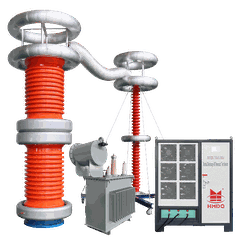




In the power industry, insulated pole test stands serve as critical auxiliary equipment for verifying the insulation performance of safety tools such as insulated poles, and their practical value is garnering widespread attention across the global power sector. Leveraging years of expertise in high-voltage testing technology, Wuhan Goldhome Hipot Electric Co., Ltd. offers its HM-DZJ and HMJYG series of insulated pole test stands. With core features such as intelligent control, precise adjustment, and efficient testing, these stands provide professional solutions for the preventive testing of electrical safety tools.
The Core Platform for Insulated Pole Withstand Voltage Testing
The primary purpose of Goldhome's insulated pole test stands is to serve as a dedicated platform for AC withstand voltage testing of insulated poles. In accordance with the requirements of DL/T1476-2015 "Regulations for Preventive Testing of Power Safety Tools," insulated poles must undergo periodic withstand voltage testing to verify their insulation performance. Goldhome's test stands are suitable for both whole-pole and sectional testing of insulated poles across voltage levels ranging from 10 kV to 500 kV.
For insulating poles rated at 35 kV and below, a full-pole test method may be used; however, for insulating poles rated at 63 kV and above, a segmented test is required. Goldhome's test stand features a unique three-electrode design that supports a two-segment withstand voltage structure, enabling the completion of withstand voltage tests for two segments of an insulating pole in a single operation, thereby significantly improving testing efficiency. When using the voltage-doubling mode to apply reverse-polarity voltage to the main and auxiliary electrodes, the test voltage can be doubled, meeting the testing requirements for higher voltage levels.
Batch Testing and Efficiency Improvement
Goldhome deeply understands the need for large-scale testing of safety tools faced by power operation and maintenance units. Traditional testing methods suffer from low efficiency due to the dispersion of sites and a relative shortage of testing equipment and personnel. Statistics show that completing the annual testing of 492 insulated poles requires 48 hours and 6 working days.
The Goldhome insulated pole test stand addresses this challenge through optimized design. It can test up to 15 insulated poles simultaneously in a single session, and its electrodes utilize a combination of grooved conductive foam to achieve a fully enveloping contact. The self-locking opening and closing mechanism facilitates the loading and unloading of test samples, significantly improving work efficiency. The test stand features calibrated scales, allowing for intuitive and accurate distance adjustment to ensure consistency in every test.
Intelligent Adjustment and Precise Control
The core advantage of the Goldhome Insulated Pole Test Stand lies in its intelligent electrode adjustment function. The device employs dual control methods-button operation and wireless remote control-enabling the auxiliary electrodes to be electrically driven to expand or retract synchronously on both sides. It also features a fine-tuning function for precise adjustment of electrode spacing, accommodating the testing requirements of insulated poles of varying lengths.
Multiple Sizes for Various Testing Scenarios
- Goldhome offers insulating rod test stands in multiple sizes to meet testing requirements for different voltage levels:
- 50kV Testing Range: Stand height 950mm, suitable for 10kV insulating rod testing
- 100kV testing range: Stand height 1250mm, capable of testing 8 samples
- 150kV testing range: Stand height 1550mm, suitable for 35-63kV insulated poles
- 200kV test range: Stand height 2200mm, suitable for segmented testing of 110–500kV insulating poles
The HM-DZJ model features 100kV withstand voltage capability, with an adjustable electrode spacing range of 300–900mm. All models utilize conductive sponge as the wrapping electrode to ensure good contact with the surface of the insulating pole.


