

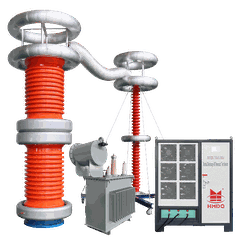



Hey there! As a supplier of high voltage testing equipment, I often get asked about how our gear measures capacitance. It's a pretty cool topic, and I'm excited to break it down for you in this blog post.
First off, let's talk a bit about what capacitance is. In simple terms, capacitance is the ability of a component or circuit to store an electrical charge. It's measured in farads (F), but in most real - world applications, we deal with much smaller units like microfarads (μF), nanofarads (nF), and picofarads (pF).
Now, high voltage testing equipment is crucial in various industries, from power generation to electronics manufacturing. Measuring capacitance accurately is essential for ensuring the proper functioning of electrical components and systems.
The Basics of Capacitance Measurement
One of the most common methods for measuring capacitance using high voltage testing equipment is the bridge method. A bridge circuit is a type of electrical circuit that compares an unknown component (in this case, a capacitor) with known components. The most well - known bridge for capacitance measurement is the Schering bridge.
The Schering bridge works by balancing the impedance of the unknown capacitor against known resistors and capacitors. When the bridge is balanced, there is no current flowing through the detector (usually a galvanometer). By adjusting the known components, we can calculate the value of the unknown capacitance.
Let's say we have an unknown capacitor (C_x) and we want to measure its capacitance. The Schering bridge consists of four arms: two resistive arms ((R_1) and (R_2)), a known capacitor (C_s), and the unknown capacitor (C_x). When the bridge is balanced, the following relationship holds:


[C_x=\frac{R_1}{R_2}C_s]
This is a simplified explanation, but it gives you an idea of how the bridge method works. Our high voltage testing equipment is designed to accurately implement these bridge circuits, allowing for precise capacitance measurement.
Another Method: The Charge - Discharge Method
Another way our high voltage testing equipment can measure capacitance is through the charge - discharge method. In this method, the capacitor is first charged to a known voltage (V) using a high voltage source. The charge (Q) stored on the capacitor is given by the formula (Q = C\times V), where (C) is the capacitance.
After charging, the capacitor is discharged through a known resistor (R). The time it takes for the capacitor to discharge is measured. The voltage across the capacitor during discharge follows an exponential decay curve, given by the formula (V(t)=V_0e^{-\frac{t}{RC}}), where (V_0) is the initial voltage, (t) is the time, (R) is the resistance, and (C) is the capacitance.
By measuring the time it takes for the voltage to decay to a certain level, we can calculate the capacitance. Our high voltage testing equipment is equipped with precise timers and voltage sensors to accurately measure these parameters and calculate the capacitance.
High Voltage and Capacitance Measurement
You might be wondering why high voltage is used in capacitance measurement. Well, there are a few reasons. Firstly, high voltage can help to detect any insulation problems in the capacitor. When a high voltage is applied, if there are any defects in the capacitor's insulation, it can cause partial discharges.
Partial discharges are small electrical discharges that occur within the insulation material. They can lead to degradation of the insulation over time and eventually cause the capacitor to fail. Our high voltage testing equipment, such as the AC Resonant Test System with PD, is designed to detect and measure these partial discharges while also measuring capacitance.
Secondly, high voltage can be used to test the capacitor under more realistic operating conditions. In many applications, capacitors are subjected to high voltages, so testing them at high voltages gives a better indication of their performance in real - world scenarios.
Our High Voltage Testing Equipment for Capacitance Measurement
We offer a range of high voltage testing equipment that is specifically designed for capacitance measurement. For example, our Oil - Immersed Non - PD Transformer is used to provide a stable high voltage source for capacitance measurement. It is designed to minimize partial discharges, ensuring accurate and reliable testing.
Our SF6 Gas PD Testing Transformer is another great option. SF6 gas is an excellent insulating material, and this transformer can be used to apply high voltages to capacitors while also detecting any partial discharges.
Importance of Accurate Capacitance Measurement
Accurate capacitance measurement is crucial for several reasons. In power systems, capacitors are used for power factor correction. If the capacitance value is incorrect, it can lead to inefficient power usage and increased energy costs.
In electronics, capacitors are used in various circuits, such as filters and oscillators. Incorrect capacitance values can cause these circuits to malfunction, leading to product failures.
Our high voltage testing equipment is designed to provide accurate capacitance measurement, helping our customers ensure the quality and reliability of their electrical components and systems.
Conclusion
So, there you have it! That's how our high voltage testing equipment measures capacitance. Whether it's using the bridge method or the charge - discharge method, our equipment is designed to provide accurate and reliable results.
If you're in the market for high voltage testing equipment for capacitance measurement or any other electrical testing needs, we'd love to hear from you. We have a wide range of products that can meet your specific requirements. Don't hesitate to reach out to us for more information or to start a procurement discussion.
References
- Electrical Engineering Handbook, Third Edition, edited by Richard C. Dorf
- Principles of Electric Circuits: Conventional Current Version, by Thomas L. Floyd


