
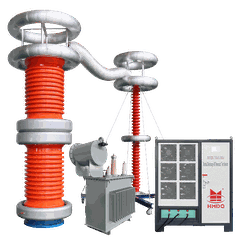



The principle of high-voltage insulation and withstand voltage equipment mainly includes the following aspects:
Voltage application: High voltage insulation withstand equipment generates adjustable high voltage through a high voltage generator, ranging from several thousand volts to several hundred thousand volts. These high voltages are applied to the tested material through an electrode system, which includes a high voltage electrode and a ground electrode for clamping the tested material.
Voltage control: The boosting method can be selected as uniform boosting or stepwise boosting. The boost rate can be set according to standards or requirements, and common boost rates include 0.5 kV/s or 1 kV/s. During the boosting process, the equipment will monitor the current passing through the material in real time. When the current suddenly increases indicating breakdown occurs, the equipment will record the voltage value at this time, which is the breakdown voltage.
Security protection: The device has overcurrent protection and overvoltage protection functions. When the current exceeds the set value, the equipment will automatically cut off the high voltage; When the voltage exceeds the set value, the equipment will automatically stop boosting to ensure the safety of the testing process.

Testing principle: High voltage insulation withstand equipment measures the voltage value at which the tested object does not experience breakdown or flashover within a certain period of time by applying a certain AC or DC high voltage, in order to evaluate its electrical insulation strength. When the applied voltage exceeds the insulation capacity of the tested object, breakdown or flashover will occur, and the equipment will record the breakdown voltage value or issue an alarm signal.
Operating procedures: When using high-voltage insulation and withstand voltage equipment, it is necessary to follow the standard operating procedures. For example, before connecting the power supply, the voltage regulator must be adjusted to the zero position before connecting the power supply; During the boosting process, close attention should be paid to the condition of the measuring instruments and the test sample. If any abnormalities are found, the voltage should be immediately reduced and the power should be cut off.
Misjudgment analysis and avoidance: In withstand voltage testing, the setting of leakage current directly affects the test results. A set value that is too small may result in qualified products being misjudged as unqualified products, while a set value that is too large may result in unqualified products being misjudged as qualified products. To avoid misjudgment, a reasonable lower limit current can be set to ensure the effectiveness of the test.