




What is the resonant frequency of an AC circuit?
There are two important components in an AC circuit: inductance and capacitance. The resistance to changes in current provided by inductance is called inductive reactance, while that provided by capacitance is called capacitive reactance. Inductive reactance increases as frequency increases, while capacitive reactance decreases as frequency increases.
When a certain frequency causes the inductive reactance to equal the capacitive reactance exactly, the circuit enters a state of "resonance." This specific frequency is called the resonant frequency.
The resonant frequency is determined jointly by the inductance (L) and capacitance (C) in the circuit, and is calculated using the formula: fr = 1 / (2π√(LC)). In other words, as long as L and C are fixed, the resonant frequency remains constant; it is an inherent characteristic of the circuit itself.
To help illustrate this concept, imagine a swing. A swing has a fixed oscillation frequency; if you push it in rhythm with that frequency, the swing will swing higher and higher-this is resonance. Resonance in an AC circuit works similarly: if the power supply frequency matches the circuit's resonant frequency, energy is continuously exchanged between the inductor and capacitor, causing the current in the circuit to become very large, while the power supply only needs to replenish a small amount of energy lost.
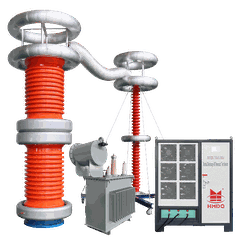
This phenomenon is ingeniously utilized in high-voltage equipment testing. Equipment such as power cables and transformers inherently possess capacitance; when paired with an adjustable inductor and a variable-frequency power supply, they can form a series resonant circuit. When the power supply frequency is tuned to the resonance point, a high voltage far exceeding the supply voltage is generated across the test specimen, while the actual power output from the supply is very small. This is why a power supply of just tens of kilowatts can perform withstand voltage tests at hundreds of kilovolts.
The application of resonance frequency is not limited to testing; it is also essential for radio tuning and filter design. Simply put, the resonant frequency is the frequency at which a circuit operates most "in sync"; at this frequency, the circuit exhibits specific amplification or frequency-selective characteristics.
Understanding the resonant frequency allows one to grasp the operating principles of many electrical and electronic devices. In the context of high-voltage testing, it is precisely through the use of the resonant frequency that the "small power supply, high voltage" testing effect is achieved, significantly reducing the power supply requirements for on-site testing.


