



300V 150A Battery Discharge Tester for Battery Testing
HM-300V/150A Battery Discharge Tester for Battery Capacity Evaluation and Maintenance
Battery performance testing is an important part of maintaining reliable DC power systems. Over time, battery capacity can decline due to aging, repeated charge-discharge cycles, operating conditions, and improper maintenance. A controlled discharge test helps maintenance personnel evaluate battery performance under a defined load.
The HM-300V/150A Battery Discharge Tester from Goldhome is designed for battery pack discharge testing, with real-time monitoring of voltage, discharge current, test duration, and discharge capacity. It can support battery activation, initial charge-discharge procedures, and maintenance testing, depending on the battery type and applicable test procedure.
For battery maintenance teams, electrical testing contractors, and industrial users, selecting a suitable discharge tester requires more than checking its maximum voltage and current. The battery configuration, discharge requirements, measurement accuracy, operating conditions, and protection functions should also be considered.
1. What Is a 300V 150A Battery Discharge Tester?
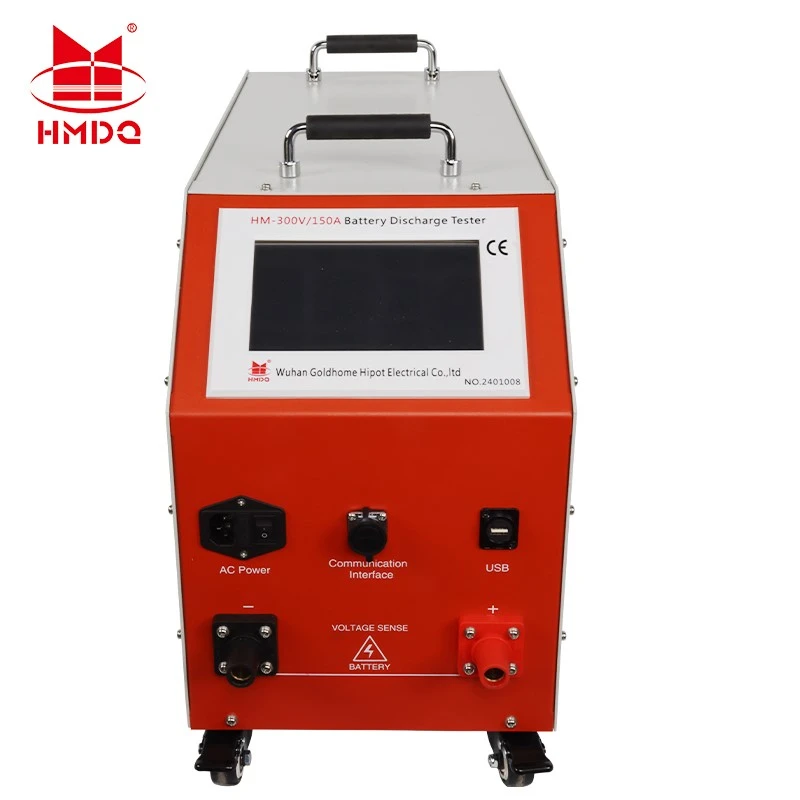
A 300V 150A battery discharge tester is an instrument designed to discharge battery packs under controlled conditions and record relevant electrical parameters.
The HM-300V/150A uses a built-in load to discharge the connected battery pack. During testing, the instrument monitors key parameters to help users evaluate the discharge process and calculate the delivered capacity.
Typical applications include:
Battery discharge and capacity evaluation.
Battery maintenance and performance checks.
Initial charge-discharge procedures.
Battery activation where supported by the battery manufacturer's instructions.
Inspection of battery packs used in industrial and DC power systems.
The actual test procedure should be selected according to the battery chemistry, rated capacity, operating voltage, and manufacturer's recommendations.
2. Key Features of the HM-300V/150A Battery Discharge Tester
-
Real-Time Discharge Monitoring
The tester monitors battery voltage, discharge current, discharge duration, and discharge capacity during the test.
These measurements help operators observe voltage changes, record the discharge process, and compare results against established maintenance criteria.
-
Controlled Discharge Testing
A controlled discharge provides a defined load for evaluating battery performance. The appropriate discharge current and termination voltage depend on the battery manufacturer's specifications and the intended test method.
Users should confirm the available discharge modes and current limits for the selected voltage range before configuring a test.
-
Data Management
The instrument includes a USB data transfer interface and an external communication expansion connector, supporting data transfer and potential system integration according to the available configuration.
Recorded test data can help maintenance teams document battery performance and compare results from different inspection periods.
-
Practical Equipment Design
The published product information lists a main unit weight of approximately 23 kg and dimensions of 645 × 263 × 425 mm (W × D × H).
These dimensions help users plan equipment transportation, storage, and installation at the test site.
3. Technical Specifications
The following table summarizes the available specifications for the HM-300V/150A Battery Discharge Tester.
| Parameter | Specification |
|---|---|
| Model | HM-300V/150A |
| Equipment type | Battery discharge tester |
| Nominal voltage class | Up to 300 V DC |
| Maximum rated discharge current | Up to 150 A, subject to voltage-range limits |
| AC input | Single-phase 220 V AC |
| Monitoring parameters | Battery voltage, discharge current, discharge time, and discharge capacity |
| Display | Touchscreen LCD |
| Data interface | USB data transfer |
| Communication | External communication expansion connector |
| Main unit weight | Approximately 23 kg |
| Dimensions | 645 × 263 × 425 mm (W × D × H) |
Important: The maximum discharge current depends on the battery voltage range and equipment operating limits. The 300 V and 150 A ratings should not be interpreted as a guaranteed simultaneous operating point. Confirm the complete voltage-current operating curve, power rating, measurement accuracy, and available discharge modes in the applicable technical datasheet before purchase.
4. How Does a Battery Discharge Tester Work?
A battery discharge tester applies a controlled electrical load to a connected battery pack and monitors its response throughout the test.
The general testing process includes the following steps.
Step 1: Check the Battery Specifications
Before testing, identify the battery chemistry, nominal voltage, rated capacity, permitted discharge current, and specified end-of-discharge voltage.
Confirm that the battery is compatible with the tester's voltage and current ranges.
Step 2: Connect the Battery Pack
Connect the discharge cables according to the manufacturer's wiring instructions. Check the positive and negative terminals, cable condition, connector ratings, and polarity before starting.
Step 3: Configure the Test Parameters
Set the appropriate discharge current, termination voltage, and test duration or capacity limit where supported.
The test settings should follow the battery manufacturer's recommendations and the applicable maintenance procedure.
Step 4: Monitor the Discharge Process
During discharge, observe the battery voltage, current, elapsed time, and accumulated capacity.
Unexpected voltage drops, abnormal heating, or other unusual conditions should be investigated according to the relevant safety procedure.
Step 5: Review the Results
At the end of the test, review the recorded data and compare the measured capacity with the applicable acceptance criteria.
For a constant-current discharge, the delivered capacity can be calculated from the discharge current and time:
Capacity (Ah) = Discharge Current (A) × Discharge Time (h)
For example, a battery discharging at 50 A for 4 hours delivers 200 Ah over that period, assuming the current remains constant.
This example illustrates the calculation only. Actual capacity evaluation must account for the specified end voltage, battery temperature, test conditions, and the manufacturer's rating method.
5. Where Is a 300V 150A Battery Discharge Tester Used?
-
Industrial DC Power Systems
Industrial DC power systems may use battery banks to provide backup power for control, protection, and other critical functions.
Periodic discharge testing can help maintenance teams evaluate battery performance and identify deterioration that may not be apparent during normal standby operation.
-
Substations and Electrical Utilities
Substations often rely on battery systems to support protection relays, control circuits, and emergency DC supplies.
A suitable discharge tester can support scheduled battery maintenance and capacity checks, subject to the site's safety procedures and battery testing requirements.
-
UPS Backup Systems
Uninterruptible power supply (UPS) systems depend on batteries to maintain power during an interruption of the main supply.
Discharge testing can help evaluate available battery capacity and support maintenance planning. Testing should be performed with appropriate isolation or an approved procedure to prevent unintended loss of backup power.
-
Battery Manufacturing and Service
Battery manufacturers and service providers may use discharge testing during inspection, maintenance, or performance evaluation.
The selected equipment must match the battery chemistry, voltage, current, capacity, and required test profile. A discharge tester should not be assumed to support every battery type or charging procedure without confirmation.
6. How to Choose the Right Battery Discharge Tester
Selecting a discharge tester requires matching the equipment to the actual battery system and testing requirements.
6.1 Battery Voltage Range
Check the maximum battery voltage and the full operating range of the instrument.
A tester rated for up to 300 V DC may cover several battery system voltages, but the usable range and maximum current must be verified for each operating point.
6.2 Discharge Current and Power
Confirm the current required by the battery's rated capacity and the selected test procedure.
The required discharge power is calculated as:
Power (W) = Battery Voltage (V) × Discharge Current (A)
For example, 200 V at 50 A represents 10 kW of discharge power. This calculation can help determine whether a tester's voltage-current limits and load capacity are suitable for the intended test.
Do not select a tester based on current rating alone.
6.3 Measurement Accuracy
Review voltage measurement accuracy, current measurement accuracy, display resolution, and the method used to calculate discharge capacity.
These factors affect the reliability of test results and their suitability for comparison against battery acceptance criteria.
6.4 Protection Functions
Check the available protection functions, including overtemperature protection, reverse-polarity protection, overcurrent protection, abnormal-condition handling, and emergency stopping.
The specific functions available should be confirmed in the technical documentation for the selected model.
6.5 Data Recording and Reporting
For routine maintenance, data recording can make it easier to compare battery performance across inspection periods.
Confirm the available data export formats, communication interfaces, storage capacity, and software compatibility if automated reporting is required.
6.6 Operating Environment
Battery discharge generates heat in the load system. Ensure adequate ventilation, keep air inlets and outlets clear, and operate the tester within the manufacturer's specified environmental conditions.
The published HM-300V/150A operating instructions call for indoor use, a dry and well-ventilated environment, and unobstructed ventilation space.
7. Battery Discharge Testing: Important Safety Considerations
Battery discharge testing involves high DC current and potentially significant stored energy. Proper preparation is essential.
Before starting a test:
Confirm that the battery voltage and polarity are compatible with the tester.
Inspect discharge cables and connectors for damage.
Verify that the discharge current and termination settings are appropriate.
Provide adequate ventilation and keep the cooling airflow unobstructed.
Follow the battery manufacturer's precautions for the specific battery chemistry.
Use suitable personal protective equipment and follow site electrical safety procedures.
Stop the test if abnormal heating, unexpected voltage behavior, or equipment alarms occur.
Never disconnect high-current battery cables while significant current is flowing unless the equipment's approved procedure explicitly permits it.
For installations where batteries support critical loads, testing must be coordinated with the responsible maintenance personnel to avoid compromising system availability.
8. Goldhome HM-300V/150A Battery Discharge Tester
Goldhome (Wuhan Goldhome Hipot Electrical Co., Ltd.) provides electrical testing equipment for power and industrial applications.
The HM-300V/150A Battery Discharge Tester is designed for controlled battery pack discharge and monitoring of key test parameters. It can support battery maintenance and performance evaluation when configured for the battery system and test procedure.
For technical specifications, operating instructions, and configuration details, visit the official product page:
HM-300V/150A Battery Discharge Tester:
https://www.goldhomehipot.com/battery-test-device/battery-charge-discharge-machine/battery-discharge-test-set.html
Before ordering, provide the battery voltage, rated capacity, battery chemistry, required discharge current, and intended application so that the appropriate configuration can be confirmed.
9. Frequently Asked Questions
1.What is a 300V 150A battery discharge tester used for?
It is used to apply a controlled discharge load to compatible battery packs and monitor voltage, current, elapsed time, and delivered capacity. Applications may include battery maintenance and performance evaluation.
2.Can the HM-300V/150A test 12V, 48V, 110V, and 220V battery systems?
These are common battery system voltage classes within the general range of many battery discharge testers. Confirm the exact supported voltage range and maximum discharge current for each voltage before using the HM-300V/150A with a particular battery system.
3.Does a battery discharge test measure battery capacity?
A controlled discharge test can measure delivered capacity under defined conditions. The result should be compared with the battery's rated capacity using the manufacturer's specified discharge rate, temperature, and end voltage.
4.Can this tester be used for lithium batteries?
Compatibility depends on the battery voltage, chemistry, configuration, current limits, and required discharge procedure. Confirm suitability with the manufacturer before testing lithium battery packs.
5.What is the difference between a battery discharge tester and a battery charger?
A battery discharge tester applies a load to draw energy from a battery and measure its response. A battery charger supplies energy to recharge the battery. A discharge tester should not be assumed to provide charging functionality unless the specified model explicitly supports it.
6.What information is needed to select a battery discharge tester?
Important details include battery voltage, capacity, chemistry, required discharge current, end-of-discharge voltage, test duration, data recording requirements, and operating environment.
Conclusion
A 300V 150A battery discharge tester can support controlled battery testing and maintenance when its operating range matches the battery system.
For the Goldhome HM-300V/150A, users should evaluate the full voltage-current limits, load capacity, measurement accuracy, monitoring functions, and protection features before selecting a configuration.
By matching the tester to the battery specifications and following a documented discharge procedure, maintenance teams can obtain useful capacity data and make more informed decisions about battery condition and service requirements.


