



Running a Portable GC Without Helium: Hydrogen and Nitrogen Carrier Gas in Practice
How to Select an Alternative Carrier Gas for Portable Gas Chromatography and Transformer Oil DGA
Helium has traditionally been used as a carrier gas in gas chromatography (GC). However, supply availability, operating costs, and field-testing requirements have encouraged users to consider alternative gases.
Hydrogen and nitrogen are two possible alternatives. Both can support specific gas chromatography applications, but they differ in separation performance, operating conditions, safety requirements, and compatibility with analytical systems.
For power utilities, transformer maintenance teams, and electrical testing laboratories, the key question is not simply whether a portable gas chromatograph can operate without helium. It is whether the selected carrier gas can deliver reliable results for the intended analysis.
1. Why Run a Portable GC Without Helium?
A carrier gas transports sample components through the chromatographic column. Its properties influence the separation process, analysis time, and overall measurement performance.
When helium is expensive, difficult to obtain, or inconvenient to transport to remote testing locations, an alternative carrier gas may help simplify gas supply management.
Potential benefits include:
Reducing dependence on helium supplies.
Lowering carrier gas costs in suitable applications.
Supporting field testing where gas availability is limited.
Improving analysis throughput when a validated method permits faster operation.
However, changing the carrier gas is not always a direct replacement. The instrument, gas supply system, detector, column, and analytical method must all be suitable for the alternative gas.
For portable gas chromatographs, these requirements are especially important because the instrument may operate in different environments and under different gas supply conditions.
2. Hydrogen vs. Nitrogen: What Is the Difference?
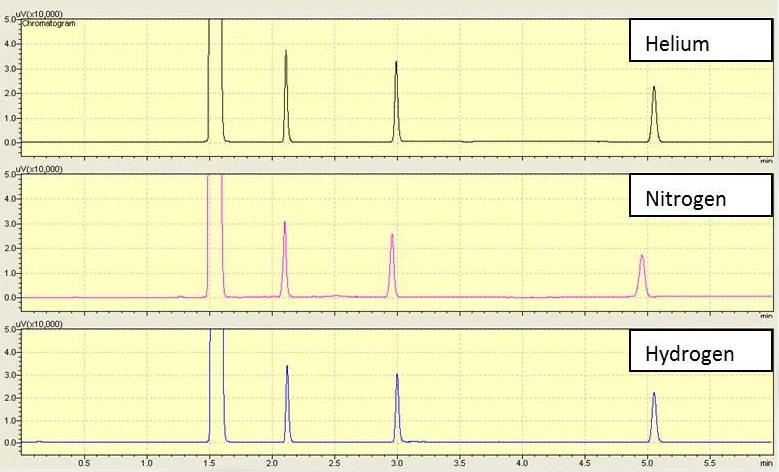
Hydrogen and nitrogen offer different advantages. The appropriate choice depends on the required separation, target gases, detector configuration, and operating environment.
| Selection Factor | Hydrogen (H₂) | Nitrogen (N₂) |
|---|---|---|
| Separation speed | Can support faster analysis under suitable conditions | Often requires lower linear velocity |
| Separation efficiency | Can provide good efficiency over a useful range of flow rates | Can provide good resolution at an appropriate, usually lower, flow rate |
| Operating cost | May reduce carrier gas costs where supply is practical | Often economical and widely available |
| Safety | Flammable; requires appropriate engineering controls | Non-flammable under normal operating conditions |
| Method adjustment | Flow, pressure, and temperature conditions may need revision | Flow and temperature conditions may need revision |
| Main consideration | Flammability and possible chemical interactions | Longer analysis time or reduced resolution if conditions are unsuitable |
The table provides general guidance rather than a universal performance ranking. Actual results depend on the column, instrument configuration, sample composition, and analytical method.
3. Using Hydrogen as a Carrier Gas
Hydrogen has relatively high diffusivity and can support efficient chromatographic separation at higher linear velocities than nitrogen in many GC applications.
For some methods, this can reduce analysis time while maintaining acceptable separation. Hydrogen may therefore be worth evaluating when field-testing efficiency is important.
3.1 Advantages of Hydrogen
Potential advantages include:
Shorter analysis times under suitable operating conditions.
Good separation efficiency with a properly optimized method.
Reduced dependence on helium supplies.
Potential savings in operating costs, depending on gas generation or supply arrangements.
These benefits must be confirmed through method validation. Switching gases without adjusting the operating conditions can change retention times, peak resolution, and measurement performance.
3.2 Hydrogen Safety Requirements
Hydrogen is highly flammable. Using it as a carrier gas requires a risk assessment and compliance with the instrument manufacturer's safety instructions.
Before operation, users should verify:
The GC and all connected components are approved for hydrogen carrier gas.
Regulators, tubing, fittings, and seals are compatible with the intended gas and pressure.
Appropriate leak detection and ventilation measures are in place.
Any required hydrogen sensors and automatic shutdown functions are installed and operational.
Operators are trained in hydrogen handling and emergency procedures.
Do not assume that a portable GC designed for helium can safely use hydrogen without modification. The manufacturer's approved configuration takes priority over general guidance.
Hydrogen may also interact with certain sample components or analytical system surfaces. For methods sensitive to these effects, additional testing and method adjustments may be necessary.
4. Using Nitrogen as a Carrier Gas
Nitrogen is non-flammable, widely available, and often economical. It can be suitable for GC methods that do not require high linear velocities or very short analysis times.
For portable gas analysis, nitrogen may be attractive where operational simplicity and gas availability are important.
4.1 Advantages of Nitrogen
Potential benefits include:
No hydrogen-specific flammability risk from the carrier gas.
Broad availability from industrial and specialty gas suppliers.
Potentially low gas supply costs.
Suitability for selected GC methods with adequate separation margins.
Nitrogen is not automatically safer in every respect: compressed-gas cylinders and pressure systems still require appropriate handling and controls.
4.2 Limitations of Nitrogen
Nitrogen has a narrower useful range of linear velocities for efficient separation in many capillary GC applications.
If a method is transferred directly from helium to nitrogen without optimization, some components may become less well separated. Reducing the flow velocity can improve resolution, but this may increase the analysis time.
Nitrogen can therefore be a practical option when:
The existing method has sufficient separation margin.
Longer analysis times are acceptable.
The target components remain adequately resolved.
Validation confirms that measurement performance meets the application requirements.
For closely eluting gas components, the revised method should be checked carefully before the instrument is used for routine testing.
5. Can Hydrogen or Nitrogen Be Used for Transformer Oil DGA?
Transformer oil dissolved gas analysis (DGA) is an important application of gas chromatography in the power industry.
DGA measures gases generated by thermal and electrical processes inside oil-filled equipment. Common target gases include hydrogen, methane, ethane, ethylene, acetylene, carbon monoxide, and carbon dioxide.
Before these gases can be analyzed by GC, the dissolved gases must generally be extracted from the insulating oil using a suitable method.
A portable gas chromatograph intended for transformer oil DGA must therefore be evaluated as part of a complete analytical system, not as an isolated instrument.
5.1 Check the Target Gas List
Confirm that the selected instrument and analytical method can measure all required gases over the expected concentration ranges.
This is particularly important when evaluating hydrogen as a carrier gas because the target list may itself include hydrogen. The detector and analytical configuration must be capable of measuring the required components reliably with the chosen carrier gas.
5.2 Confirm Detector Compatibility
Different detectors respond differently to carrier gases. For example, thermal conductivity detection (TCD) depends on differences in thermal conductivity between the carrier gas and the measured components.
A carrier gas change can affect the detector signal, sensitivity, baseline behavior, and calibration requirements.
Users should confirm compatibility with the manufacturer's documentation rather than assume that all TCD or flame ionization detector (FID) systems support the same gas configurations.
5.3 Validate the Complete DGA Method
A suitable validation process should examine:
Gas extraction efficiency from transformer oil.
Separation of the required gas components.
Detection limits and measurement ranges.
Calibration and repeatability.
Interference and baseline stability.
Consistency with the applicable analytical procedure.
IEC 60567:2023 provides guidance on sampling free gases and analyzing free and dissolved gases in insulating liquids. Users should also verify the relevant oil-sampling requirements and applicable editions of standards for their particular testing procedure.
Changing the carrier gas does not, by itself, establish compliance with a DGA standard.
6. Practical Steps for Switching from Helium
A controlled method transfer is more reliable than simply replacing one gas cylinder with another.
Step 1: Check Instrument Compatibility
Review the GC manufacturer's instructions for hydrogen or nitrogen operation. Check the complete flow path, sample introduction system, detector, pressure controls, and any required safety equipment.
Step 2: Review the Existing Method
Record the original carrier gas, column specification, flow rate, inlet conditions, oven temperature program, detector settings, and expected retention times.
These values provide a reference for evaluating the alternative method.
Step 3: Adjust Operating Conditions
The appropriate changes depend on the selected gas and column. Flow rate, pressure, oven temperature program, and analysis time may need to be revised.
Use manufacturer-approved method conversion guidance where available.
Step 4: Run Reference Samples
Analyze suitable calibration mixtures or reference samples containing the target components. Check peak identification, resolution, response, and repeatability.
For transformer oil DGA, validation should include the sample extraction process, not only direct injection of a gas mixture.
Step 5: Verify Measurement Performance
Confirm that the alternative method meets the required detection limits, accuracy, repeatability, and reporting requirements.
Update the operating procedure and train personnel before using the revised method for routine testing.
7. Which Carrier Gas Should You Choose?
There is no single best carrier gas for every portable GC application.
Consider hydrogen when:
Faster analysis is an important objective.
The instrument is approved for hydrogen.
Appropriate safety controls are available.
The method can be validated with acceptable analytical performance.
Consider nitrogen when:
Non-flammable carrier gas is preferred.
Gas availability and operating cost are key considerations.
The method can achieve the required separation at a suitable flow rate.
A longer analysis time is acceptable.
Keep helium when:
The existing validated method depends on helium.
Alternative gases introduce unacceptable analytical or operational changes.
The manufacturer or applicable procedure requires helium.
The final decision should balance analytical performance, instrument compatibility, safety, supply arrangements, and the cost of the complete testing process.
8. Goldhome: Supporting Electrical Testing and Transformer Diagnostics
Goldhome (Wuhan Goldhome Hipot Electrical Co., Ltd.) focuses on high-voltage electrical testing equipment and solutions for the power industry.
Reliable transformer condition assessment may involve several complementary activities, including insulating oil analysis, electrical testing, and insulation condition evaluation. Gas chromatography is one of the analytical techniques used to support this work.
When selecting gas analysis equipment for transformer oil DGA, users should define the target gas components, detection requirements, sample preparation procedure, and applicable standards before confirming the instrument configuration.
For technical consultation on electrical testing equipment and transformer diagnostic applications, visit the Goldhome official website:
Website: https://www.goldhomehipot.com/
WhatsApp: 18971538425
Conclusion
Hydrogen and nitrogen can provide alternatives to helium for selected portable gas chromatography applications. Hydrogen may offer faster separation, while nitrogen can provide an economical, non-flammable option where the method allows suitable operating conditions.
For transformer oil DGA, the priority is to maintain reliable measurement of the required gas components. Instrument compatibility, sample extraction, detector response, calibration, safety, and method validation should all be considered before changing carrier gases.
A carefully validated configuration can help power utilities and transformer maintenance teams manage gas supplies while maintaining the analytical performance required for equipment condition assessment.


