

350 kV / 350 kVA SF₆ Gas-Insulated High-Voltage Test System with Partial Discharge-Free Design

1. Product Introduction
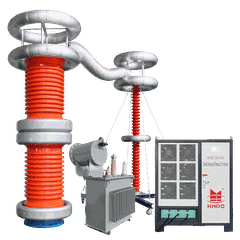
The 350 kV / 350 kVA SF₆ Gas-Insulated High-Voltage Test System is designed for high-voltage electrical testing applications that require a compact insulation structure and controlled partial discharge performance.
The system uses sulfur hexafluoride (SF₆) gas insulation in its high-voltage structure. Its partial discharge-free design objective is to reduce internal discharge and background interference during testing, supporting reliable high-voltage withstand and partial discharge measurement applications when properly configured.
With a rated voltage of 350 kV and a rated capacity of 350 kVA, the system can be considered for laboratory testing, electrical equipment manufacturing, and high-voltage insulation evaluation. The actual test capability depends on the system configuration, load characteristics, duty cycle, and specified test procedure.
2. Key Technical Specifications
| Parameter | Specification |
|---|---|
| Rated voltage | 350 kV |
| Rated capacity | 350 kVA |
| Insulation structure | SF₆ gas-insulated |
| Design feature | Partial discharge-free design |
| Equipment category | High-voltage testing system |
| Typical application | High-voltage insulation and withstand testing |
| Actual partial discharge level | To be confirmed in the technical datasheet |
| Input power supply | To be confirmed |
| Output frequency | To be confirmed |
| Control system | To be confirmed |
| Applicable standards | To be confirmed according to the test application |
Important: "Partial discharge-free design" describes a design objective, not proof of zero measurable discharge under every operating condition. The guaranteed background partial discharge level should be confirmed through the manufacturer's specifications and acceptance testing.
3. Why Use SF₆ Gas Insulation?
SF₆ has strong electrical insulating properties and has traditionally been used in high-voltage equipment. In an appropriately engineered gas-insulated structure, it can help achieve high dielectric strength within a relatively compact arrangement.
Potential engineering advantages include:
Compact high-voltage structure: Gas insulation can support a more space-efficient arrangement than some conventional air-insulated designs.
Electrical insulation performance: The insulating gas helps withstand high electric-field stress when the enclosure, electrode geometry, gas condition, and pressure are properly designed.
Enclosed construction: A sealed enclosure can protect internal components from some external environmental influences.
Controlled discharge performance: Careful design of electrodes, insulation interfaces, surface finishes, and internal clearances can help limit partial discharge sources.
Actual equipment dimensions, gas pressure, maintenance intervals, and environmental performance depend on the specific design and must be confirmed with the manufacturer.
SF₆ is a potent greenhouse gas. Equipment owners should follow applicable regulations and use appropriate gas handling, leak prevention, recovery, and recycling procedures.
4. Partial Discharge-Free Design: Why It Matters
Partial discharge (PD) is a localized electrical discharge that does not completely bridge the insulation between conductors. In high-voltage test equipment, unwanted discharge from the test system itself can interfere with the measurement of discharge activity in the test object.
A partial discharge-free design aims to minimize this background interference through coordinated electrical and mechanical engineering.
Important design considerations may include:
Smooth electrode surfaces and appropriate high-voltage connections.
Suitable electric-field distribution and insulation clearances.
Carefully designed gas-insulated interfaces and enclosure geometry.
Effective shielding and grounding arrangements.
Low-interference measurement connections and suitable PD instrumentation.
Verification of background discharge under defined test conditions.
The final background PD level depends on the complete test setup, including the power source, connecting leads, voltage divider, test object, grounding, and measurement environment. A low-PD claim should therefore be supported by a stated measurement method and factory acceptance results.
5. Typical Applications
High-Voltage Insulation Withstand Testing
The system may be configured for AC withstand tests on compatible high-voltage electrical equipment. Test voltage, duration, and load requirements must be matched to the equipment under test.
Partial Discharge Measurement
When integrated with a suitable PD measuring system, the high-voltage source can support partial discharge evaluation of electrical insulation. The achievable background noise and sensitivity must be verified for the complete setup.
Electrical Equipment Manufacturing
Manufacturers of high-voltage components may use a suitably configured system for production testing, quality control, and design verification.
High-Voltage Laboratories
Testing laboratories can evaluate insulating components and assemblies according to the required test procedure, provided the system's output characteristics and capacity meet the test requirements.
Application note: The system's exact suitability for GIS, transformers, cables, bushings, or other test objects should be established from the rated output, load capacitance, test frequency, duty cycle, and relevant standards.
6. How to Evaluate a 350 kV / 350 kVA System
Voltage and capacity are important, but they are not sufficient to determine whether a high-voltage test system is suitable for a specific project.
| Selection factor | Why it matters |
|---|---|
| Rated output voltage | Must meet the required test voltage and margin specified by the test procedure |
| Rated capacity | Must support the electrical load at the required operating conditions |
| Load capacitance | Affects the current and power demand in capacitive test applications |
| Test frequency | Must be compatible with the specified test method |
| Partial discharge background | Determines whether the system can support the required PD measurement sensitivity |
| Voltage measurement | Accuracy, calibration, and measurement configuration should meet the project requirements |
| Operating duty | Continuous and short-time ratings may differ |
| Gas system | Confirm gas pressure, density monitoring, leakage control, and maintenance requirements |
| Safety features | Verify interlocks, grounding provisions, overvoltage protection, and emergency shutdown |
| Acceptance testing | Confirm factory tests, documentation, and the procedure for verifying performance |
For capacitive loads under sinusoidal AC conditions, the approximate reactive power is:

where (f) is frequency, (C) is load capacitance, and (V) is RMS voltage. This relationship helps explain why the actual load and test frequency must be considered alongside the rated capacity.
7. Standards and Compliance
The applicable standards depend on the test object and test method. The project specification may refer to relevant parts of the IEC 60060 series for high-voltage test techniques and IEC 60270 for conventional partial discharge measurement.
The applicable editions, measurement bandwidth, calibration procedure, background-noise limit, and acceptance criteria should be agreed before testing.
Do not assume that a 350 kV rating automatically establishes compliance with a particular test standard. Compliance depends on the complete system design, verification results, and intended application.
8. Frequently Asked Questions
Q1: What does 350 kV / 350 kVA mean?
350 kV is the stated rated voltage, while 350 kVA is the stated rated apparent power capacity. The permissible combination of voltage, load, and operating duration must be confirmed from the technical specification.
Q2: Does partial discharge-free design mean the measured PD value is always zero?
No. It indicates a design objective to minimize unwanted discharge. The actual background PD level should be specified and verified under defined test conditions.
Q3: Why is SF₆ used in high-voltage equipment?
SF₆ has strong insulating properties and can support compact gas-insulated structures. Its environmental impact means gas containment, recovery, and responsible handling are important.
Q4: Can this system test GIS or high-voltage cables?
Potentially, depending on the configuration and test method. Suitability must be verified against load capacitance, required test voltage, frequency, capacity, and the relevant standard.
Q5: What should be confirmed before ordering?
Confirm the rated voltage and capacity, test method, output frequency, supported load, partial discharge background limit, gas-system requirements, control and protection functions, and factory acceptance test criteria.
9. Goldhome High-Voltage Testing Solutions
Wuhan Goldhome Hipot Electrical Co., Ltd. supplies high-voltage testing equipment for power utilities, electrical equipment manufacturers, EPC contractors, and testing laboratories.
For a 350 kV / 350 kVA SF₆ gas-insulated system with a partial discharge-free design, the final configuration should be matched to the required test object, voltage level, load characteristics, and partial discharge measurement target.
Manufacturer: Wuhan Goldhome Hipot Electrical Co., Ltd.
Website: https://www.goldhomehipot.com
Contact: +86 18971538425
Contact Goldhome to confirm the detailed technical specifications, available configurations, and acceptance test requirements for your application.