

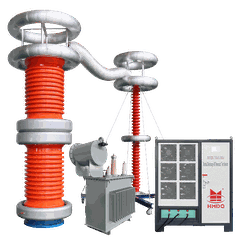


In the field of preventive testing for electrical safety tools, the insulated boot tester serves as the core equipment for verifying the insulation performance of insulated boots. The scientific validity of its operating principles directly impacts the accuracy of test data and the safety of personnel. Leveraging years of expertise in high-voltage testing technology, Wuhan Goldhome Hipot Electric Co., Ltd. has developed the HMJS-T1 fully automatic insulated boot (glove) withstand voltage test unit. Utilizing three core technologies-electromagnetic induction voltage boosting, multi-channel synchronous data acquisition, and infrared data isolation-this device provides safe and reliable testing solutions for the global power industry. This article will provide an in-depth analysis of the working principle of the Goldhome insulated boot tester.
Principle of Electromagnetic Induction Voltage Boosting
The core operating principle of the Goldhome insulated boot tester is based on power-frequency high-voltage generation technology. The device is connected to a 0–220 V power-frequency power supply. After the voltage is adjusted by an induction voltage regulator, it is fed into the test transformer. Utilizing the principle of electromagnetic induction, the low voltage is boosted to a power-frequency high voltage of 0–100 kV and applied to the electrodes of the insulated boots placed in a water tank. The test transformer features a gas-filled design with a capacity of up to 10 kVA. Its output voltage range is continuously adjustable from 0 to 100.0 kV, with a voltage measurement error of less than ±(1.0%U + 0.1%Umax), ensuring precise and stable test voltage.
During the voltage ramp-up process, the equipment adheres to the voltage rise rate specified by national standards-rising at a rate of 1 kV/s to 75% of the specified test voltage, then at a rate of 100 V/s to the target value. Once the predetermined voltage is reached, the system automatically starts timing and maintains the test voltage at a stable level.
Multi-Channel Synchronous Leakage Current Acquisition
The core technological innovation of the Goldhome tester lies in its patented multi-channel high-voltage leakage current measurement technology. The device supports simultaneous testing of up to 8 pairs of insulated boots (or gloves), with each test item equipped with an independent leakage current sampling channel. The measurement range is 0–25.0 mA, with a resolution as high as 0.01 mA and a measurement error of ±(1.0% I + 0.1 counts).
The leakage current sampling unit is independently powered by a 12V lithium battery and uses high-precision sensors to collect real-time leakage current values for each test item. This design completely isolates the sampling circuit from the high-voltage system, ensuring measurement accuracy while eliminating the risk of high voltage entering the measurement system. Sampling data is wirelessly transmitted to the control unit via infrared communication technology, achieving complete electrical isolation between the high- and low-voltage sides.
Intelligent Protection and Independent Disconnection Mechanism
When any test specimen experiences breakdown or the leakage current exceeds the set threshold, the Goldhome tester's independent protection mechanism is immediately triggered-the affected specimen is automatically disconnected from the high-voltage circuit, while other specimens continue testing normally without mutual interference. The protection response time is less than 20 milliseconds, effectively preventing the escalation of faults.
The device features built-in multiple protections against overvoltage and overcurrent. When the test voltage exceeds the set value or the total input current becomes abnormal, the system automatically cuts off the high-voltage output and reduces the voltage back to zero. The control unit uses a high-precision stepper motor to control the voltage regulator, achieving fully automatic closed-loop control of the entire process, including voltage ramp-up, timing, voltage ramp-down, and power disconnection.
Innovative Dry Testing Method
Addressing the challenge of drying insulated boots after traditional water-injection testing, the Goldhome tester supports a dry testing method. During testing, the insulated boot is filled with metal steel balls no larger than 4 mm in diameter and at least 15 mm in height, which serve as the internal electrodes in place of water. The steel balls maintain good contact with the high-voltage electrodes, satisfying conductivity requirements while eliminating the cumbersome process of water injection and drying, thereby significantly improving testing efficiency.


