

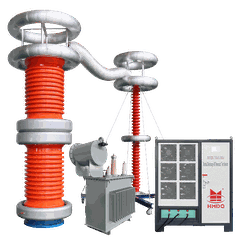


Why PD-Free High Voltage Testing Matters for Transformer and GIS Manufacturing | Goldhome
As power grids expand and high-voltage equipment becomes more demanding, manufacturers need reliable methods to verify insulation performance before electrical equipment is delivered to customers. Partial discharge (PD) measurement, combined with appropriate high-voltage testing, is an important part of quality control for many types of high-voltage apparatus.
A PD-free high voltage test set is designed to minimize partial discharge activity generated by the test system itself. This helps reduce background interference during testing and supports the detection of weak discharge signals from the equipment under test.
For transformer manufacturers, GIS production facilities, and high-voltage testing laboratories, understanding the relationship between background discharge, measurement sensitivity, and insulation quality is essential for effective factory testing.

1. Why Partial Discharge Testing Matters in High-Voltage Equipment Manufacturing
Partial discharge is a localized electrical discharge that only partially bridges the insulation between conductors. It may occur in insulation systems affected by voids, interfaces, protrusions, contamination, or other defects.
Repeated partial discharge activity can contribute to insulation deterioration over time. Detecting relevant discharge activity during manufacturing and acceptance testing can therefore help engineers assess insulation quality before equipment enters service.
Typical applications include:
Power transformers: Evaluating insulation performance during specified factory tests.
Gas-insulated switchgear (GIS): Checking insulation performance in gas-insulated assemblies and components.
Instrument transformers: Assessing insulation integrity in current and voltage transformers.
High-voltage bushings and insulators: Identifying discharge activity associated with insulation defects.
Other high-voltage apparatus: Supporting quality assurance according to the applicable test procedure.
The required test method and acceptance criteria depend on the equipment type, rated voltage, applicable standards, and customer specifications.
2. Why Low Background Partial Discharge Is Important
During a partial discharge measurement, the test system can generate unwanted electrical interference or discharge signals. If the background level is too high, weak signals from the test object may become more difficult to distinguish.
A PD-free high voltage test set is designed to reduce this problem through appropriate high-voltage component design, shielding, insulation arrangements, and control of potential discharge sources.
A low background level can provide several benefits:
Improved distinction between system background and signals from the test object
More suitable conditions for measuring low-level discharge activity
Better consistency when conducting repeat tests under comparable conditions
Support for factory quality control and documented test procedures
However, low background discharge does not automatically guarantee a particular measurement sensitivity. The complete measurement circuit, detector, coupling components, calibration arrangement, and test environment also affect measurement performance.
3. PD-Free AC Withstand Testing for Transformers and GIS
Transformers and GIS equipment have different electrical structures and test requirements. Their high-voltage test systems must therefore be matched to the intended application.
-
Transformer Factory Testing
Power transformers undergo specified electrical tests to verify insulation performance and compliance with applicable requirements. Where partial discharge measurement is required, the test arrangement must provide suitable high-voltage output and sufficiently low background interference.
The system configuration depends on transformer voltage class, test voltage, required capacity, and the applicable test procedure.
-
GIS Factory Testing
GIS equipment uses compact gas-insulated structures. Testing may involve complete assemblies, individual chambers, or specific insulation components, depending on the manufacturing process and test requirements.
For GIS applications, the test system must account for the equipment's electrical load, connection arrangement, and required test voltage. Specialized configurations may be used to facilitate testing in manufacturing facilities or during on-site commissioning.
Industry technical guidance also identifies high-voltage withstand testing combined with partial discharge measurement as an important consideration for GIS/GIL and transformer applications. CIGRE technical publication

4. Key Factors Affecting Partial Discharge Measurement Quality
A reliable PD test depends on more than the high-voltage source alone.
| Factor | Importance in testing |
|---|---|
| Test system background PD | Helps determine whether unwanted discharge activity may interfere with measurement. |
| Measurement sensitivity | Determines the ability to detect weak signals under specified conditions. |
| Shielding and grounding | Help control interference and unwanted discharge sources. |
| Coupling and detection components | Affect how discharge signals are acquired and measured. |
| Calibration | Supports the reliability of the measurement chain. |
| Test environment | Electrical noise, connections, and surrounding equipment can affect results. |
| Test procedure | Defines the voltage conditions, measurement method, and acceptance criteria. |
For this reason, manufacturers should evaluate the performance of the complete test arrangement rather than relying only on a single background PD figure.
5. How PD-Free Test Systems Support Factory Quality Control
When integrated into a suitable factory testing process, a PD-free high voltage test set can support several quality-control activities.
Before testing: Engineers verify the test connections, grounding, measurement circuit, and required test settings.
During testing: The system applies the specified voltage while the relevant electrical parameters and partial discharge signals are monitored.
After testing: Results are reviewed against the applicable test requirements and recorded as part of the equipment's quality documentation.
This process supports more consistent test execution and provides useful records for factory acceptance testing and customer documentation.
The exact test sequence and acceptance criteria must follow the applicable standard, equipment specification, and approved procedure.
6. Goldhome PD-Free High Voltage Testing Solutions
Goldhome focuses on high-voltage electrical testing equipment and test system solutions for power-sector applications.
Its product portfolio includes PD-free high-voltage testing solutions intended for relevant electrical insulation testing applications. Depending on the selected configuration, system requirements may involve rated voltage, output capacity, background partial discharge performance, measurement equipment, control functions, and protection arrangements.
For transformer and GIS manufacturers, the appropriate system should be determined by the test object and the required procedure. Technical specifications and factory test documentation should be reviewed to confirm the performance of the selected model.
To learn more about Goldhome's high-voltage testing equipment, visit the Goldhome official website.
Conclusion
Partial discharge testing is an important consideration in the quality assurance of many high-voltage electrical products. A PD-free high voltage test set helps minimize discharge activity generated by the test system, creating more suitable conditions for measuring discharge signals from the test object.
For transformer manufacturers, GIS production facilities, and high-voltage laboratories, effective testing depends on the complete measurement arrangement, appropriate system configuration, and compliance with the relevant test procedure.
Goldhome provides high-voltage testing equipment solutions for applications where insulation performance and reliable test results are important. Selecting a suitable system begins with understanding the test object, required voltage, capacity, and partial discharge measurement requirements.


