



Troubleshooting: Why Can't Your AC Resonant Test System Find the Resonance Point?
AC resonant withstand voltage test systems rely on precise frequency scanning and tracking to match the load parameters of capacitive equipment-such as cables, transformers, and GIS-thereby achieving series resonance voltage boost. However, during on-site high-voltage testing, issues frequently arise where the system cannot lock onto the resonance point, the voltage fails to rise, and the test terminates prematurely. Understanding the root causes of these issues and the troubleshooting approach can effectively improve on-site testing efficiency and prevent operational errors and wasted effort.
The most common primary cause is a mismatch between the load parameters and the reactors. Each set of resonant reactors has a fixed inductance compatibility range corresponding to specific cable lengths and capacitance ranges. If the cable under test is too long or too short, or if the load capacitance exceeds the compatibility range of the series-parallel reactor configuration, the system will be unable to find an effective frequency that balances inductive reactance and capacitive reactance, resulting in a failed resonance scan. This is also the primary factor preventing resonance from being established on-site.

The second most common cause is abnormal on-site wiring and connections that interfere with resonance detection. Loose wiring, poor grounding, incorrect series-parallel configurations of reactors, and abnormal voltage divider wiring can all cause circuit impedance irregularities. The device's built-in frequency scanning program cannot identify stable circuit characteristics and is therefore unable to lock onto the resonance point. In addition, moisture in test leads, damaged insulation, and strong on-site electromagnetic interference can all affect signal acquisition, leading to resonance scan failure
.
The third category of issues involves incorrect parameter settings and equipment hardware failures. Unreasonable frequency scan range settings, inappropriate overvoltage protection thresholds, and insufficient excitation voltage can all prevent the system from inducing resonance. At the same time, hardware issues such as aging variable-frequency drive modules, failures in the host's variable-frequency unit, and sampling data deviations in the voltage divider can directly cause the automatic frequency scanning and tracking functions to malfunction, making it impossible to complete resonance matching.
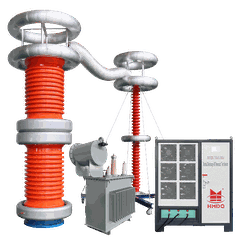
To address these issues, operators should first verify the compatibility between the reactor and the load, thoroughly inspect the integrity of the wiring and the grounding status, eliminate on-site interference, and reset the test parameters. The Goldhome AC Resonance Test System is equipped with intelligent, fully automatic frequency scanning and fault alert functions, which can quickly pinpoint abnormalities, significantly reduce the difficulty of on-site troubleshooting, and ensure the stable and efficient completion of high-voltage withstand tests.


