

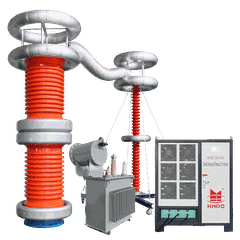


HMFRC-200 High-Voltage Measuring Divider: 200 kV AC/DC Voltage Measurement for High-Voltage Testing
1. Introduction: Accurate Voltage Measurement in High-Voltage Testing
High-voltage testing requires a reliable measurement system to monitor the voltage applied to electrical equipment.
During AC withstand testing, DC high-voltage testing and insulation performance evaluation, engineers need to measure the actual output voltage rather than rely only on the control setting of the high-voltage power source.
The HMFRC-200 High-Voltage Measuring Divider is designed for measuring power-frequency AC and DC high voltages up to its rated measurement level.
The system consists of a high-voltage divider and a low-voltage digital display meter connected through a dedicated coaxial cable. It uses an RC voltage division principle to convert the high-voltage input into a lower-level measurement signal.
With a stated rated voltage of 200 kV AC and 200 kV DC, the HMFRC-200 is intended for high-voltage testing applications in electrical laboratories, power equipment manufacturing facilities and field testing environments.
2. What Is the HMFRC-200 High-Voltage Measuring Divider?
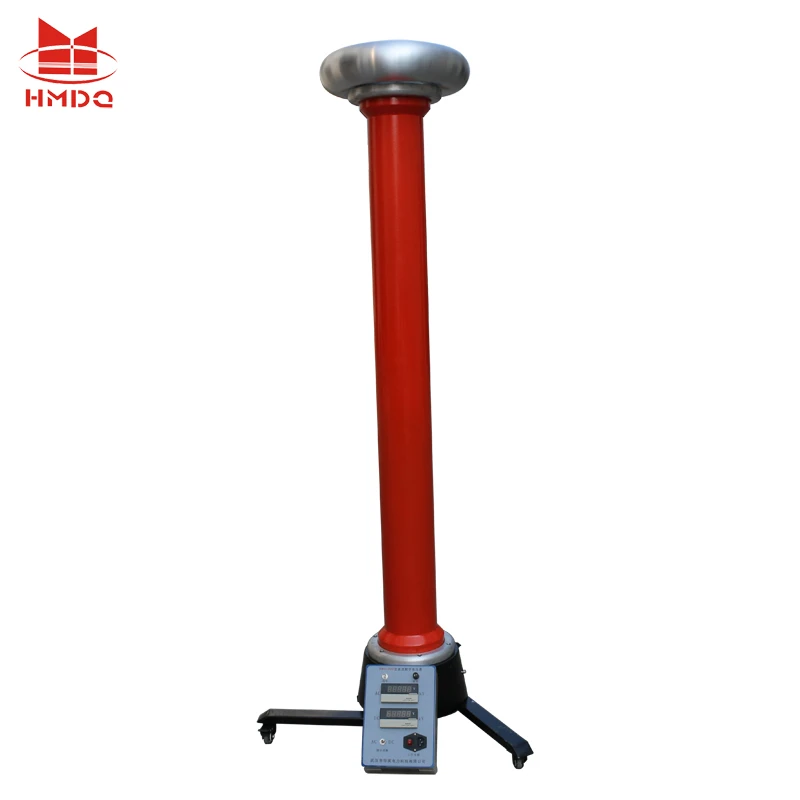
The HMFRC-200 is a high-voltage measuring instrument designed to measure high-voltage AC and DC signals.
Its main structure includes two functional sections:
High-voltage divider
The high-voltage section receives the voltage signal from the test circuit and reduces it according to the specified voltage division ratio.
Low-voltage digital display meter
The measuring instrument receives the divided signal through a coaxial cable and displays the corresponding high-voltage measurement.
This arrangement allows operators to read the measured voltage from the low-voltage instrument instead of directly approaching the high-voltage measurement point.
The HMFRC-200 uses dry-type insulation and an RC voltage divider structure. Its compact design supports transportation, installation and use in high-voltage testing environments.
3. Working Principle of the HMFRC-200
A high-voltage divider converts an input voltage into a proportional lower-voltage signal.
For a divider with a voltage division ratio of 1000:1:
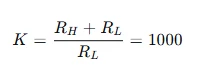
Where:
(K) = voltage division ratio
(UH) = high-voltage input
(UL) = low-voltage output
The output voltage can be calculated as:
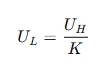
For example, when the input voltage is 200 kV:

The low-voltage measurement signal is then transmitted to the digital display meter through the coaxial cable.
The measuring instrument uses the calibrated division ratio to display the corresponding high-voltage value.
Why Is a Voltage Divider Needed?
Direct measurement of high voltage is difficult because conventional measuring instruments cannot be connected directly to very high-voltage circuits.
A voltage divider provides a controlled measurement interface by reducing the voltage to a level suitable for the measuring instrument.
The overall measurement result depends on more than the nominal division ratio. The divider, connecting cable, measuring instrument, grounding arrangement and operating environment must work together as a properly calibrated measurement system.
4. HMFRC-200 Technical Specifications
According to the current Goldhome product page, the published specifications are as follows:
| Parameter | HMFRC-200 Specification |
|---|---|
| Model | HMFRC-200KV |
| Rated AC Voltage | 200 kV |
| Rated DC Voltage | 200 kV |
| Voltage Divider Impedance | 2400 MΩ |
| Standard Voltage Division Ratio | 1000:1 |
| AC Measurement Accuracy | 1.0% |
| DC Measurement Accuracy | 0.5% |
| Insulation Type | Dry-type |
| Insulation Material | DuPont dry-type insulation material, as stated on the product page |
| Coaxial Cable | 4 m |
| Operating Temperature | 0°C to 40°C |
| Ambient Humidity | ≤85% RH |
Note: Specifications should be checked against the actual product nameplate, approved datasheet and calibration documentation before procurement or publication.
5. AC and DC High-Voltage Measurement
The HMFRC-200 is specified for both AC and DC high-voltage measurement.
Although both measurement modes use the same basic voltage division concept, their measurement characteristics and accuracy specifications are different.
5.1 AC High-Voltage Measurement
AC high-voltage measurement is required in applications such as:
AC withstand voltage testing
Power-frequency high-voltage testing
Transformer insulation testing
Switchgear dielectric testing
High-voltage laboratory experiments
The published AC measurement accuracy for the HMFRC-200 is 1.0%.
For AC measurements, the displayed quantity and its definition should be confirmed with the instrument documentation. In particular, engineers should verify whether the required reading is RMS voltage, peak voltage or another specified measurement value.
5.2 DC High-Voltage Measurement
DC high-voltage measurement is used in applications such as:
DC insulation testing
DC withstand testing
High-voltage power supply monitoring
Electrical insulation research
The published DC measurement accuracy is 0.5%.
For DC testing, the divider should be connected with the correct polarity and grounding arrangement according to the manufacturer's operating instructions.
6. Main Applications of the HMFRC-200
6.1 AC Withstand Voltage Testing
During AC withstand testing, the voltage divider measures the high voltage applied to the test object.
It can be used as part of a high-voltage measurement arrangement for electrical insulation testing.
Typical test objects include:
Power transformers
Switchgear
Insulators
Electrical components
High-voltage cables and accessories, where the measurement arrangement is suitable
6.2 DC High-Voltage Testing
The HMFRC-200 can also be used to measure DC high voltage in test circuits.
It provides a measurement interface between the high-voltage circuit and the digital display instrument.
The actual measurement setup should be selected according to the DC source characteristics and the divider's approved operating range.
6.3 Electrical Equipment Manufacturing
Electrical equipment manufacturers require voltage measurement during production testing and quality control.
A high-voltage divider can support measurement of the applied voltage during insulation testing and other specified high-voltage procedures.
6.4 High-Voltage Testing Laboratories
Testing laboratories use high-voltage measuring systems to monitor applied voltage and record test conditions.
The HMFRC-200 can be incorporated into suitable AC/DC high-voltage test arrangements, subject to the laboratory's measurement requirements and calibration procedures.
7. HMFRC-200 Compared with a Traditional Electrostatic Voltmeter
High-voltage measuring dividers and electrostatic voltmeters use different measurement arrangements.
| Comparison | HMFRC-200 Divider | Traditional Electrostatic Voltmeter |
|---|---|---|
| Measurement principle | RC voltage division | Electrostatic force |
| Main structure | High-voltage divider and digital meter | Electrostatic measuring instrument |
| Display | Digital display meter | Instrument-specific display |
| Connection | Dedicated coaxial measurement cable | Direct electrostatic measurement arrangement |
| Application | AC/DC high-voltage measurement within rated specifications | High-voltage measurement within instrument ratings |
The choice depends on the required voltage range, measurement uncertainty, installation arrangement, calibration and operating environment.
8. How to Install and Use a High-Voltage Measuring Divider
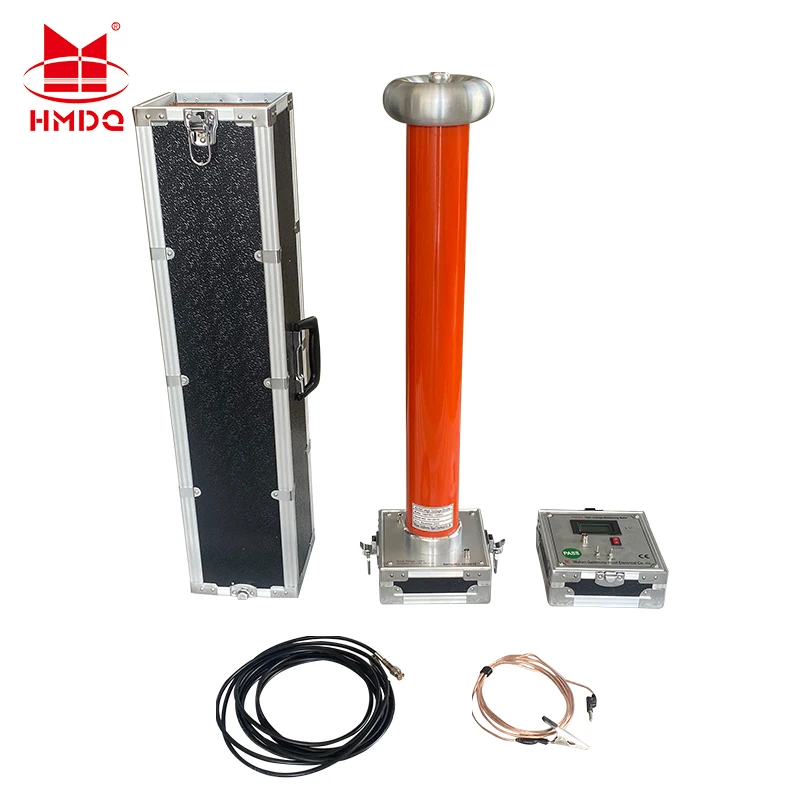
Correct installation is essential for reliable high-voltage measurement.
A typical setup includes the following steps:
Step 1: Inspect the equipment
Check the divider body, measuring instrument, coaxial cable, terminals and insulation surfaces before installation.
Step 2: Position the divider
Place the divider on a suitable stable surface with the required electrical clearances from grounded structures and other energized equipment.
Step 3: Connect the grounding system
Establish the grounding connection according to the manufacturer's instructions and the approved test circuit.
Step 4: Connect the measuring cable
Connect the dedicated coaxial cable between the divider and the low-voltage measuring instrument.
Step 5: Check the measurement system
Verify the instrument settings, division ratio, cable connection and display operation before applying high voltage.
Step 6: Apply the test voltage
Operate the high-voltage source according to the approved test procedure and monitor the displayed voltage.
Step 7: Complete the test safely
After testing, reduce the voltage to zero, isolate the power source and discharge and ground the test object and associated circuit as required.
Never disconnect the divider or measuring cable while the high-voltage circuit is energized.
9. Key Factors When Selecting a High-Voltage Measuring Divider
When selecting a high-voltage divider for a testing laboratory or field application, engineers should consider the following factors.
9.1 Rated Measurement Voltage
The divider must be suitable for the maximum voltage expected in the test circuit.
For the HMFRC-200, the published AC and DC rated voltages are both 200 kV.
9.2 Voltage Division Ratio
The division ratio determines the relationship between the high-voltage input and low-voltage output.
The published standard ratio for the HMFRC-200 is 1000:1.
The actual ratio should be verified through calibration and checked against the connected measuring instrument.
9.3 Measurement Accuracy
The published measurement accuracy is:
AC: 1.0%
DC: 0.5%
For applications requiring traceable measurement, the calibration certificate and measurement uncertainty should also be reviewed.
9.4 Input Impedance and Loading Effect
The input impedance of the divider influences the measurement circuit.
A suitable high-voltage measuring system should minimize unwanted loading effects on the test source while maintaining the required measurement performance.
9.5 Environmental Conditions
Temperature, humidity, contamination and installation clearances can affect insulation and measurement performance.
The operating environment should remain within the manufacturer's specified limits.
9.6 Calibration and Measurement Traceability
For laboratory and factory testing, calibration is important for demonstrating measurement performance.
IEC 60060-2:2025 provides requirements and methods for high-voltage measuring systems, including measurement uncertainty, system approval and verification of components.
10. Standards and Measurement Requirements
IEC 60060-2:2025, High-voltage test techniques – Part 2: Measuring systems, covers complete measuring systems and their components used for laboratory and factory measurements of DC, AC and impulse high voltages.
The standard also addresses measurement uncertainty, system requirements, approval and checking of measuring components.
For the HMFRC-200, users should pay attention to:
The rated voltage and measurement range
The calibrated voltage division ratio
AC and DC measurement accuracy
The measuring instrument and coaxial cable
The grounding and installation arrangement
Calibration records and measurement uncertainty
A published accuracy figure alone does not establish that the complete measurement system has been approved or calibrated to IEC 60060-2. Compliance should be supported by the relevant test and calibration documentation.
11. Goldhome HMFRC-200 High-Voltage Measuring Solution
Wuhan Goldhome Hipot Electrical Co., Ltd. provides high-voltage testing equipment and measuring instruments for power utilities, electrical manufacturers, engineering contractors and high-voltage laboratories.
The HMFRC-200 is designed for AC and DC high-voltage measurement up to its stated 200 kV rating.
Its configuration combines a high-voltage RC divider and a low-voltage digital display meter, supporting voltage measurement in suitable high-voltage testing arrangements.
For product details, technical documentation and configuration inquiries, visit:
Goldhome Hipot: https://www.goldhomehipot.com
WhatsApp:+8618971538425
12. Frequently Asked Questions
Q1. What is the maximum rated voltage of the HMFRC-200?
The current Goldhome product page specifies a rated voltage of 200 kV AC and 200 kV DC.
Q2. What is the voltage division ratio?
The published standard voltage division ratio is 1000:1.
Q3. What is the measurement accuracy of the HMFRC-200?
The published accuracy is 1.0% for AC measurement and 0.5% for DC measurement.
Q4. Can the HMFRC-200 measure both AC and DC voltage?
Yes. It is specified for both power-frequency AC and DC high-voltage measurement within its rated voltage range.
Q5. What components are included in the measuring system?
The main arrangement consists of a high-voltage divider and a low-voltage digital display meter connected by a dedicated coaxial cable. The supplied accessories should be confirmed in the quotation and packing list.
Q6. Is the HMFRC-200 suitable for impulse voltage measurement?
The current product specification describes power-frequency AC and DC measurement. Impulse voltage measurement should not be assumed to be supported without confirmation of the specific divider's transient response, bandwidth and calibration for the required impulse waveform.
Q7. Does a 1000:1 division ratio mean the output is always exactly 1/1000 of the input?
It is the nominal relationship. Actual measurement performance depends on the calibrated ratio, frequency or waveform, connected measuring instrument, cable and operating conditions.
Conclusion
The HMFRC-200 High-Voltage Measuring Divider provides a measurement solution for AC and DC high-voltage testing applications up to its published 200 kV rating.
Its RC voltage division structure, 1000:1 standard division ratio and digital display arrangement make it suitable for integration into appropriate high-voltage testing circuits.
For reliable results, users should confirm the rated voltage, measurement accuracy, calibration status, connection arrangement and environmental conditions before operation.


